The Freeman magazine was the flagship publication of the Foundation for Economic Education and one of the oldest, most respected journals of liberty in America. It was founded in 1950 through the efforts of John Chamberlain, Henry Hazlitt, Isaac Don Levine, and Suzanne La Follette. FEE acquired it in 1956, and within two years it had reached 42,000 subscribers.

Through its articles, commentaries, and book reviews, several generations of Americans have learned about the consequences and contradictions that flow from the illiberal policies of collectivism, interventionism, and the welfare state. For 66 years, The Freeman uncompromisingly defended the ideals of a free society.

FEE announced in September 2016 that the Fall 2016 issue would be the final edition of The Freeman magazine. Selected back issues are available at the FEE Store, and all issues are available here as downloads.

In June 2025, The Freeman was relaunched, but this time for the modern era on Substack. Subscribe for articles on markets, liberty, and culture from the perspective of anti-anti-anti-Communists.

Copyright Notice

Unless otherwise noted, and with the exception of John Stossel’s “Give Me a Break!” columns, all works published on FEE.org and FEE.org/freeman are published under a Creative Commons Attribution International License 4.0.

Feel free to share and copy as long as you credit FEE as the source.

Print Issues Archive

Filter by Year

1995 07 cover - Home

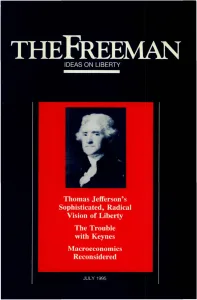
The Freeman: July 1995 Volume 45, 1995

This issue offers critiques of Keynesianism, fresh treatments of capital theory, and market-based perspectives on medicine and environmental management. Authors examine World War II internment policy, the rise of market-based management, and the parable of liberty lost to the promise of false security. Additional essays address European political integration, preservation politics, monetary institutions, and Jefferson’s radical vision of liberty.
20121112 coveraug95small - Home

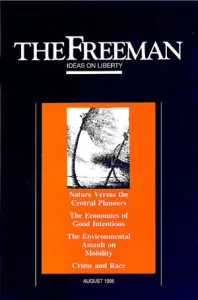
The Freeman: August 1995 Volume 45, 1995

This issue contrasts good intentions with good outcomes, illustrating how central planning, environmental regulation, and redistribution undermine prosperity and personal responsibility. Contributors review unemployment dynamics, the ethics of political rhetoric, the meaning of justice in diverse societies, and the persistent inequities of progressive taxation. Additional articles revisit life behind the Iron Curtain, explore crime and culture, examine educational vouchers, and honor Maria Montessori’s legacy of child-centered learning.

20121112 coversep95small - Home

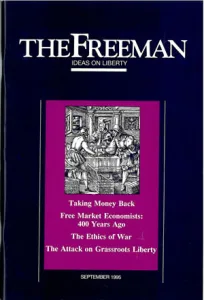
The Freeman: September 1995 Volume 45, 1995

This issue ranges from monetary theory to 400-year-old roots of free-market scholarship, examining war ethics, constitutional federalism, and the modern push for politically correct consumption. Articles critique legislation-driven legal systems, defend mergers, expose the minimum-wage illusion, and make the case for privatizing unemployment insurance. Additional essays address property-rights conflicts, free trade, immigration, criminal justice, the welfare state, public finance, and the enduring relevance of H. L. Mencken’s defense of liberty.

20121112 coveroct95small - Home

The Freeman: October 1995 Volume 45, 1995

This issue explores the foundations of liberty through defenses of trial by jury, critiques of political overreach, and analyses of how self-interest channels human behavior in productive rather than destructive ways. Authors examine Hayek’s warning about centralized knowledge, expose the dangers of fractional-reserve banking, and highlight how campaign-finance reforms, environmental activism, and public-school initiatives often undermine the very goals they claim to advance. Additional pieces study early American champions of freedom—such as William Penn—challenge central planning in law, education, and business, and reaffirm respect for economic success, individual dignity, and the voluntary order of a free society.

20121112 covernov95small - Home

The Freeman: November 1995 Volume 45, 1995

This issue examines the moral and economic consequences of canceling the national debt, the wealth-destroying logic of forced redistribution, and the case for removing education from democratic political control. Authors explore restoring a gold standard, diagnosing the decline of the dollar, and restraining government-subsidized corporate incentives. Additional essays address church–state separation myths, freedom of religious practice, property-rights violations such as newspaper theft, the roots of environmental extremism, and Mark Twain’s fierce defense of individualism.

20121112 coverdec95small - Home

The Freeman: December 1995 Volume 45, 1995

This issue highlights the arts within a market economy, showing how capitalism enables creativity, diversity, and cultural flourishing. Articles celebrate Beethoven’s liberating genius, recount life in socialist Britain, and analyze Russia’s criminalized economy, immigration policy debates, and Austrian insights into macroeconomics. Additional pieces explore linguistic clarity in economics, the quackery of egalitarianism, and the timeless value of applying market principles to public-policy controversies.

20121112 coverjan96small - Home

The Freeman: January 1996 Volume 46, 1996

This issue examines the roots of American liberty through Paul Johnson’s reflections on history, the uplifting discipline of the Boys Choir of Harlem, and the essential economic role immigrants play in high-technology industries. Contributors explain the importance of speculation in coordinating markets, expose the punitive nature of modern welfare policies, and highlight egregious cases of government waste. Additional pieces defend property rights, warn against coercive unionism, critique employment-destroying regulations, and revisit Lord Acton’s timeless insights on political power.

20121112 coverfeb96small - Home

The Freeman: February 1996 Volume 46, 1996

This issue makes the case for restoring parental responsibility for education, outlining practical steps to separate school and state while reviewing the rich history of voluntary education before government compulsion. Authors critique the political power of teachers’ unions, examine how licensing laws block job opportunities, and recount the federal attack on educational entrepreneurship such as “Hooked on Phonics.” Essays also explore the inseparable link between liberty and responsibility, the value of competition, and Alexis de Tocqueville’s prophetic warnings about how freedom can be gained—and lost.

20121112 covermar96small - Home

The Freeman: March 1996 Volume 46, 1996

This issue interrogates classical arguments for state involvement in education, explores the Church’s evolving relationship with free-market thinking, and demonstrates how markets communicate information far more reliably than conversations. Other articles dissect ambiguous uses of rights language, critique the complexities of “flat tax” proposals, draw lessons from tax cuts in the 1920s, and reveal how estate taxes erode wealth. Further contributions challenge politicized multiculturalism, defend the virtues of failure in a market order, and celebrate Macaulay’s eloquent defense of liberty.

20121112 coverapr96small - Home

The Freeman: April 1996 Volume 46, 1996

This issue highlights how government taxes, subsidies, and welfare structures have driven New York City’s economic decline while illustrating how well-intended laws routinely produce harmful unintended consequences. Articles analyze Keynes’s legacy, celebrate personal initiative, and expose the reach of regulation in everyday life. Additional pieces explore ancient lessons on taxation, theological warnings about the welfare state, bureaucratic absurdities, the alliance between labor unions and big government, and John Locke’s lasting influence on natural-rights philosophy.

20121112 covermay96small - Home

The Freeman: May 1996 Volume 46, 1996

This issue explores the economic and cultural dynamics shaping urban decline, the dangers of overregulation, and the historical patterns of confiscation and taxation stretching back to ancient Rome. Contributors critique modern welfare-state theology, expose bureaucratic irrationality, and analyze how union-government alliances harm economic freedom. Essays also examine the meaning of justice, the hidden costs of sexual-harassment policy, the career of commercial poet Berton Braley, and the enduring significance of Locke’s defense of rights.

20121112 coverjun96small - Home

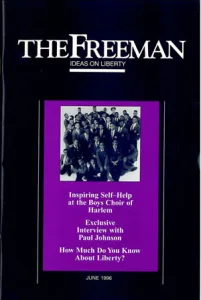
The Freeman: June 1996 Volume 46, 1996

This issue argues that a bloated welfare state undermines both prosperity and civic virtue, analyzing the costs of redistribution, the political obstacles to reform, and the importance of individual responsibility. Articles examine foreign-aid failures, the economics of food stamps, the shifting politics of welfare, and the distortions caused by federal spending priorities. Additional essays highlight the entrepreneurial spirit, revisit the historical meaning of liberty, and assess the dangers of government dependency.