The Freeman magazine was the flagship publication of the Foundation for Economic Education and one of the oldest, most respected journals of liberty in America. It was founded in 1950 through the efforts of John Chamberlain, Henry Hazlitt, Isaac Don Levine, and Suzanne La Follette. FEE acquired it in 1956, and within two years it had reached 42,000 subscribers.

Through its articles, commentaries, and book reviews, several generations of Americans have learned about the consequences and contradictions that flow from the illiberal policies of collectivism, interventionism, and the welfare state. For 66 years, The Freeman uncompromisingly defended the ideals of a free society.

FEE announced in September 2016 that the Fall 2016 issue would be the final edition of The Freeman magazine. Selected back issues are available at the FEE Store, and all issues are available here as downloads.

In June 2025, The Freeman was relaunched, but this time for the modern era on Substack. Subscribe for articles on markets, liberty, and culture from the perspective of anti-anti-anti-Communists.

Copyright Notice

Unless otherwise noted, and with the exception of John Stossel’s “Give Me a Break!” columns, all works published on FEE.org and FEE.org/freeman are published under a Creative Commons Attribution International License 4.0.

Feel free to share and copy as long as you credit FEE as the source.

Print Issues Archive

Filter by Year

20121111 coverjul98small - Home

The Freeman: July 1998 Volume 48, 1998

This issue explores the tension between government expansion and individual autonomy, highlighting how regulation and subsidies distort behavior and weaken accountability. Essays address welfare reform, market pricing, education policy, and the moral hazards created by political guarantees. The issue also emphasizes entrepreneurship, voluntary action, and the civic virtues that support liberty.
201211112 coveraug98small - Home

The Freeman: August 1998 Volume 48, 1998

This issue explores the relationship between technology, happiness, and human flourishing, arguing that innovation enriches life by expanding choice, easing burdens, and enabling self-improvement. Articles critique environmental policies that harm the poor, highlight lessons from zoo privatization, and examine the dangers of paternalistic lawmaking. Additional pieces address self-responsibility, economic misconceptions, moral agency, and the power of voluntary cooperation in a free society.

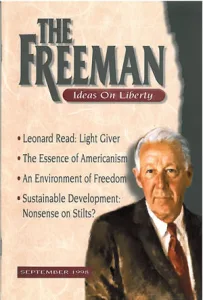
20121111 coversep98small - Home

The Freeman: September 1998 Volume 48, 1998

This issue examines how political incentives drive overspending, regulatory inflation, and institutional decline, contrasting these failures with the discipline of market processes. Contributors explore public education, trade restrictions, environmental myths, and the constitutional limits eroded by modern governance. Essays also analyze entrepreneurship, taxation, and the ethical dimensions of voluntary social cooperation.

20121111 coveroct98small - Home

The Freeman: October 1998 Volume 48, 1998

This issue explores the unintended consequences of government intervention, focusing on how regulation, taxation, and bureaucratic control undermine prosperity and personal initiative. Articles examine monetary policy, labor markets, foreign aid, and the pitfalls of technocratic planning. Additional essays highlight the strengths of spontaneous order, commercial society, and the moral logic of voluntary exchange.

20121111 covernov98small - Home

The Freeman: November 1998 Volume 48, 1998

This issue examines how entrepreneurship, property rights, and market incentives shape environmental stewardship more effectively than political regulation. Authors explore the economics of wildlife management, the ethics of voting, civil-asset forfeiture abuses, and the future of monetary innovation in a digital age. Additional essays analyze Internet development without government direction, consumer choice, natural-rights foundations, and the limits of political problem-solving.

201211111 coverdec98small - Home

The Freeman: December 1998 Volume 48, 1998

This issue explores the political and institutional roots of the East Asian financial crises, arguing that corruption, central planning, and misguided intervention—not markets—produced instability. Contributors discuss moral purpose in work, trade-deficit misconceptions, private vs. public animal-care incentives, and how market reforms have transformed global soccer. Additional articles analyze military-civilian relations, the fragility of prosperity, the costs of regulation, and the enduring moral and economic principles that support a free society.

201211111 coverjan99small - Home

The Freeman: January 1999 Volume 49, 1999

This issue explores how prosperity, innovation, and social cooperation arise from voluntary exchange rather than political design. Contributors challenge myths about economic power, regulation, and monopoly while emphasizing the role of entrepreneurship in wealth creation. Additional essays address education, trade, and the moral foundations of a free society.

20121111 coverfeb99small - Home

The Freeman: February 1999 Volume 49, 1999

This issue argues that liberty depends on personal responsibility, open markets, and limits on political authority. Articles critique government expansion into welfare, schooling, and environmental regulation while highlighting the superiority of decentralized decision-making. Other essays explore globalization, property rights, and enduring misconceptions about capitalism.

201211112 covermar99small - Home

The Freeman: March 1999 Volume 49, 1999

This issue examines how government attempts to manage economic and social life often backfire, creating perverse incentives and suppressing voluntary solutions. Contributors analyze labor markets, regulation, public schooling, and welfare policy, stressing the importance of institutional humility. Additional articles explore taxation, law, and the moral logic of freedom.

201211111 coverapr99small - Home

The Freeman: April 1999 Volume 49, 1999

This issue highlights the dangers of federal overreach, focusing on how concentrated political power threatens both economic vitality and civil society. Writers examine taxation, trade, monetary policy, and the cultural incentives that sustain liberty. Additional essays critique interventionism, regulatory expansion, and economic fallacies that justify bigger government.

201211112 covermay99small - Home

The Freeman: May 1999 Volume 49, 1999

This issue critiques government intervention from monetary policy to federal lawmaking, showing how political management distorts markets and public expectations. Contributors revisit the gold standard, evaluate Hayek’s legacy, and question enthusiasm for state-led “solutions.” Additional essays examine regulatory burdens, economic fallacies, and the institutional costs of expansive government.

20121111 coverjun99small - Home

The Freeman: June 1999 Volume 49, 1999

This issue explores the moral and economic consequences of paternalism, arguing that coercive policies—from drug prohibition to labor regulation—undermine freedom and responsibility. Authors examine education, welfare programs, and judicial overreach while highlighting how markets encourage accountability. Additional essays analyze trade, taxation, and the cultural roots of voluntary cooperation.