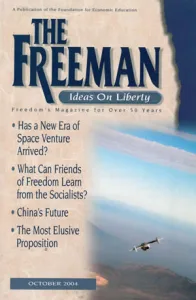
The Freeman: October 2004 Volume 54, 2004
Explores surging gasoline prices, the future of space exploration, and the impossible nature of socialism.
Explores surging gasoline prices, the future of space exploration, and the impossible nature of socialism.
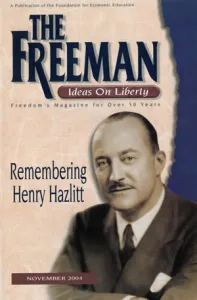
In commemoration of 110th anniversary of Henry Hazlitt’s birth, this issue focuses on why it is important to read his writings.
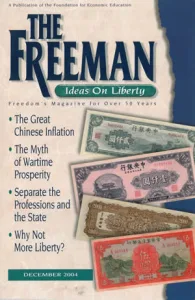
Discusses the Great Chinese Inflation of the 1930s and 1940s, the life of Richard Cobden, and a theory about we don’t have more freedom.
Highlights a formula for turning “liberals” into free-market advocates, discusses the problems with the welfare state, and reflects on William P. Lear’s vision for the world.
Discusses government-funded science, the liberating role of free trade, and corruption in Detroit.
Examines the chronic pain crisis, the basic economics behind price gouging, and the unconstitutionality of protectionism.
Reflects on academic socialism, the role of Black Americans in the liberty movement, and the state of Social Security.
Explores the actions of the Radical Patriots, the argument to separate politics and science, and the impact of light rail.
Argues that the FDA is beyond reform, that modern-day “liberals” are infatuated with politics, and that USPS bureaucrats play by their own rules.
Criticizes Social Security and its origins, the Supreme Court’s Kelo decision, and government intervention more broadly.
Explores viewpoints on Social Security and discusses the employment landscape for young Americans.
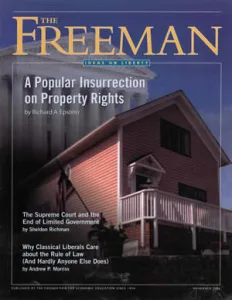
Discusses supply-and-demand analysis and the dangers of eminent domain.