The Freeman magazine was the flagship publication of the Foundation for Economic Education and one of the oldest, most respected journals of liberty in America. It was founded in 1950 through the efforts of John Chamberlain, Henry Hazlitt, Isaac Don Levine, and Suzanne La Follette. FEE acquired it in 1956, and within two years it had reached 42,000 subscribers.

Through its articles, commentaries, and book reviews, several generations of Americans have learned about the consequences and contradictions that flow from the illiberal policies of collectivism, interventionism, and the welfare state. For 66 years, The Freeman uncompromisingly defended the ideals of a free society.

FEE announced in September 2016 that the Fall 2016 issue would be the final edition of The Freeman magazine. Selected back issues are available at the FEE Store, and all issues are available here as downloads.

In June 2025, The Freeman was relaunched, but this time for the modern era on Substack. Subscribe for articles on markets, liberty, and culture from the perspective of anti-anti-anti-Communists.

Copyright Notice

Unless otherwise noted, and with the exception of John Stossel’s “Give Me a Break!” columns, all works published on FEE.org and FEE.org/freeman are published under a Creative Commons Attribution International License 4.0.

Feel free to share and copy as long as you credit FEE as the source.

Print Issues Archive

Filter by Year

coverjul84 - Home

The Freeman: July 1984 Volume 34, 1984

This issue of The Freeman examines the dangers inherent in expanding state power, showing how collectivist thinking elevates groups over individuals and leads to coercion, economic disorder, and diminished freedom. It highlights the linguistic roots of “danger” to illustrate how power itself becomes a threat, and it critiques wage controls and rigid union practices that depress productivity, destroy jobs, and hasten industrial decline. Additional essays expose the hidden costs of protectionist policies, recount how government ventures crowd out private enterprise, and trace constitutional crises to deviations from limited-government principles. The issue also explores how envy distorts notions of justice and argues that reindustrialization depends on sound money and free markets. Book reviews consider works on political stagnation and the history of railroad labor.
coveraug84 - Home

The Freeman: August 1984 Volume 34, 1984

This issue of The Freeman examines the moral foundations of private property and the dangers of the welfare state, arguing that coercive redistribution violates both economic logic and ethical principle. It critiques union-imposed wage rigidities and protectionist myths, highlights how market pricing resolved the Greyhound labor dispute, and explores the responsibilities of trustees and donors who wish to safeguard liberty across generations. Additional essays revisit the real lessons of the Gilded Age, challenge the claims of employment-protection policies, and assess the effects of airline regulation and resource allocation under scarcity. Book reviews consider works on economic crises, rural China, and national defense.

coversep84 - Home

The Freeman: September 1984 Volume 34, 1984

This issue of The Freeman examines how resilient free men and women remain even amid political pressure to conform, emphasizing that economic calculation and personal responsibility are indispensable to liberty. It critiques arguments for compulsory unionization, exposes fallacies behind claims of chronic labor shortages, and explains how entrepreneurship depends on dispersed knowledge rather than centralized planning. Additional essays explore the moral hazards of government protection, analyze cartel failures, recount the unintended results of regulation in postal services and insurance, and reflect on the discipline required to maintain a free society. Book reviews consider works on policy reform, taxation, and the decline of political order.

coveroct84 - Home

The Freeman: October 1984 Volume 34, 1984

This issue of The Freeman examines how political redistribution erodes both economic performance and moral responsibility, arguing that only voluntary exchange can sustain genuine social cooperation. It critiques the spread of dependency through transfer programs, highlights the cultural consequences of abandoning constitutional limits, and analyzes how tax policy and inflation distort incentives across industry. Additional essays explore the discipline required for personal liberty, the problems created by government price-manipulation schemes, and the market logic that drives long-distance communication and technological progress. Book reviews consider works on American politics, classical liberal thought, and the moral foundations of a free society.

covernov84 - Home

The Freeman: November 1984 Volume 34, 1984

This issue of The Freeman examines the moral and philosophical roots of liberty, arguing that genuine freedom requires personal responsibility, respect for individual rights, and restraint on government power. Articles explore the “natural” rate of unemployment, the ethics and consequences of preferential hiring, the stabilizing effects of free markets on social order, and Bastiat’s argument that rights preexist the state. Additional essays address the illusion of certainty, the limits of obligation and taxation, the dangers of demand-side interventions in medicine, and Herbert Spencer’s case for strictly limited government. Book reviews consider works on labor legislation and the philosophical thought of Ayn Rand.

coverdec84 - Home

The Freeman: December 1984 Volume 34, 1984

This issue of The Freeman explores how collective action, when detached from personal responsibility, leads to political overreach and economic distortion. It critiques wage and price controls, protectionist demands, and compulsory unionism, showing how intervention undermines productivity and restricts opportunity. Additional essays analyze inflation’s subtle harms, the entrepreneurial roots of prosperity, and the moral principles that sustain a free society. Other contributors address the decline of educational standards, the political manipulation of “needs,” and the dangers of conflating charity with coercion. Book reviews consider works on economics, public policy, and the continuing relevance of classical liberal thought.

coverjan85 - Home

The Freeman: January 1985 Volume 35, 1985

This issue of The Freeman examines the nonviolent path to freer societies, comparing Gandhi’s principled resistance with the unchecked power of modern governments. It critiques egalitarian political schemes, explains how property rights sustain prosperity, and explores the economic distortions created by planning and coercive redistribution. Additional essays defend pluralism in education, analyze the moral erosion caused by envy, and illustrate how markets transform scarcity into abundance through innovation and voluntary exchange. Book reviews consider works on political leadership, federal regulation, and the philosophical foundations of liberty. 

coverfeb85 - Home

The Freeman: February 1985 Volume 35, 1985

This issue of The Freeman examines the foundations of a market economy, emphasizing voluntary cooperation, consumer-driven production, and the moral case for individual achievement. It critiques Marxian distortions of capitalism, explains how political intervention disrupts labor markets, and shows why wages reflect productivity rather than coercive bargaining. Additional essays explore the dangers of state-directed capital accumulation, the economic consequences of protectionism, and the enduring logic behind free banking as an alternative to partial deregulation. Classic stories and commentary illustrate how interventionism breeds scarcity, while book reviews consider works on political culture, management, and the ethics of wealth.

FreemanMarch1985 - Home

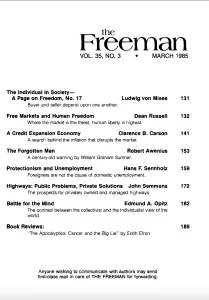
The Freeman: March 1985 Volume 35, 1985

This issue of The Freeman examines the necessity of sound economic reasoning, warning against utopian visions that ignore scarcity, incentives, and the limits of political power. It critiques the belief that government can engineer prosperity, explains how decentralized decision-making fuels innovation, and highlights education’s role in cultivating independent thought. Additional essays explore the moral foundations of voluntary exchange, the dangers of egalitarian coercion, and the practical failures of intervention in labor and commodity markets. Book reviews consider works on constitutional history, economic theory, and the philosophical defense of freedom.

coverapr85 - Home

The Freeman: April 1985 Volume 35, 1985

This issue of The Freeman examines how oppressive tax systems undermine economic vitality and moral responsibility, arguing that confiscatory policies cannot create prosperity. It explores the virtues of personal renewal and self-discipline, the practical benefits of decentralizing political authority, and the dangers of vague calls for “fairness” in public policy. Additional essays analyze the unseen costs of protectionism, the logic of market-driven pricing, and the failures of compulsory unionism. Book reviews consider works on Russian history, public policy reform, and America’s intellectual development.

covermay85 - Home

The Freeman: May 1985 Volume 35, 1985

This issue of The Freeman examines the relationship between security and liberty, arguing that genuine security can only emerge from personal responsibility and the freedom to reap the fruits of one’s labor. It critiques modern appeals to positive “rights,” exposes the dangers of egalitarian coercion, and warns against collectivist ideas that mislead the young. Additional essays explore how inflation harms societies, why industrial policy and central planning fail, and how eminent domain has expanded far beyond its legitimate scope. A final assessment contrasts capitalism’s voluntary order with socialism’s coercive ideals, and a book review analyzes the failures of state-managed economies.

coverjun85 - Home

The Freeman: June 1985 Volume 35, 1985

This issue of The Freeman explains why freedom outperforms socialism, showing how voluntary exchange, personal responsibility, and entrepreneurship create prosperity while intervention breeds distortion and dependency. It critiques U.S. farm programs for worsening the very instability they seek to cure, analyzes the conflict between “comparable worth” mandates and civil liberty, and defends profit as a moral outcome of serving others. Additional essays explore the power of language to shape political thought, present a dynamic theory of entrepreneurship, and reaffirm the importance of natural rights, private property, and the wisdom of the Founders. Book reviews consider works on economic growth, political ideology, and American public life.