The Freeman magazine was the flagship publication of the Foundation for Economic Education and one of the oldest, most respected journals of liberty in America. It was founded in 1950 through the efforts of John Chamberlain, Henry Hazlitt, Isaac Don Levine, and Suzanne La Follette. FEE acquired it in 1956, and within two years it had reached 42,000 subscribers.

Through its articles, commentaries, and book reviews, several generations of Americans have learned about the consequences and contradictions that flow from the illiberal policies of collectivism, interventionism, and the welfare state. For 66 years, The Freeman uncompromisingly defended the ideals of a free society.

FEE announced in September 2016 that the Fall 2016 issue would be the final edition of The Freeman magazine. Selected back issues are available at the FEE Store, and all issues are available here as downloads.

In June 2025, The Freeman was relaunched, but this time for the modern era on Substack. Subscribe for articles on markets, liberty, and culture from the perspective of anti-anti-anti-Communists.

Copyright Notice

Unless otherwise noted, and with the exception of John Stossel’s “Give Me a Break!” columns, all works published on FEE.org and FEE.org/freeman are published under a Creative Commons Attribution International License 4.0.

Feel free to share and copy as long as you credit FEE as the source.

Print Issues Archive

Filter by Year

20121111 coverjul99small - Home

The Freeman: July 1999 Volume 49, 1999

This issue focuses on U.S. intervention in Kosovo, arguing that military involvement lacked constitutional grounding and carried severe unintended consequences. Contributors discuss foreign policy, the resilience of markets, and the dangers of centralized authority in crisis. Additional essays consider tax fairness, income distribution, and how free markets self-correct when unhampered.
20121111 coveraug99small - Home

The Freeman: August 1999 Volume 49, 1999

This issue examines the tension between markets and coercive political control, showing how prosperity emerges from voluntary exchange rather than state design. Articles analyze Social Security, literature’s moral lessons, personal responsibility, and regulatory overreach. Contributors emphasize entrepreneurial problem-solving and warn against policies driven by envy or paternalism.

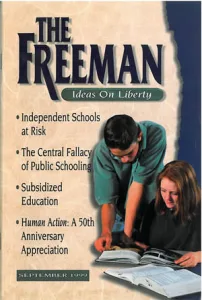
201211111 coversep99small - Home

The Freeman: September 1999 Volume 49, 1999

This issue evaluates education reform, the drug war, and expansive regulation, illustrating how efforts to “protect” society often backfire and violate individual liberty. Writers highlight the superiority of private schooling, the costs of prohibition, and historical lessons from Native American economics. Additional essays explore monetary instability, parenting, and the moral limits of redistribution.

201211112 coveroct99small - Home

The Freeman: October 1999 Volume 49, 1999

This issue explores themes of private property, entrepreneurship, monetary theory, and the growing reach of federal authority. Essays discuss encryption policy, media distortions in the drug war, the legacy of Wilhelm Röpke, and competing interpretations of Federal Reserve actions in the interwar period. The issue emphasizes the creative power of markets, the fragility of liberty under expanding government, and the enduring relevance of classical liberal economic insights.

20121111 covernov99small - Home

The Freeman: November 1999 Volume 49, 1999

This issue of The Freeman explores how political rhetoric manipulates public perception, the limits of public education systems, the moral and economic consequences of coerced redistribution, the mythology of “public health” regulation, and how political actors shape foreign policy and trade.

201211112 coverdec99small - Home

The Freeman: December 1999 Volume 49, 1999

This issue of The Freeman examines why Y2K happened, the economic meaning of population growth, states’ rights and decentralization, the dangers of overregulation, China’s turn toward Keynesianism, the cultural illusions behind collectivism, and how market processes shape everyday decisions.

20121111 coverjan00small - Home

The Freeman: January 2000 Volume 50, 2000

This issue examines how markets generate cooperation and prosperity, contrasting voluntary exchange with the coercive nature of political decision-making. Contributors highlight misperceptions about monopoly, regulation, and “public” solutions while defending entrepreneurship and personal responsibility. Additional essays explore constitutional limits, education, environmental claims, and the lasting relevance of classical liberal ideas.

20121111 coverfeb00small - Home

The Freeman: February 2000 Volume 50, 2000

This issue explores the logic of spontaneous order and how markets solve problems better than bureaucratic planning. Writers challenge myths about antitrust, scarcity, and political management of resources while emphasizing the creative power of decentralized decision-making. Additional articles address globalization, environmental fears, and the morality of capitalism.

20121111 covermar00small - Home

The Freeman: March 2000 Volume 50, 2000

This issue analyzes competition, innovation, and the institutional foundations of wealth, showing how regulation and taxation weaken economic progress. Contributors critique political rent-seeking, minimum-wage laws, and trade barriers that restrict opportunity. Additional essays examine entrepreneurship, constitutional interpretation, and the persistent dangers of central planning.

20121111 coverapr00small - Home

The Freeman: April 2000 Volume 50, 2000

This issue highlights misconceptions about poverty, welfare, and inequality, arguing that economic freedom—not government programs—creates long-term improvement. Authors critique redistributionist thinking and expose the unintended consequences of intervention in labor, housing, and social policy. Additional essays explore trade, property rights, crime, and the cultural preconditions of liberty.

20121111 covermay00small - Home

The Freeman: May 2000 Volume 50, 2000

This issue focuses on education, regulation, and the importance of individual choice in shaping social outcomes. Contributors examine failures of public schooling, licensing laws, government secrecy, and political manipulation of science. Additional articles defend free trade, entrepreneurship, and the moral case for a society built on voluntary cooperation.

20121111 coverjun00small - Home

The Freeman: June 2000 Volume 50, 2000

This issue critiques the belief that political actors can “manage” economic life, showing how incentives and dispersed knowledge limit government effectiveness. Writers explore drug policy, transportation regulation, endangered-species laws, and agricultural subsidies, illustrating the harm done by well-intended controls. Additional essays emphasize personal responsibility, constitutionalism, and the resilience of market solutions.