The Freeman magazine was the flagship publication of the Foundation for Economic Education and one of the oldest, most respected journals of liberty in America. It was founded in 1950 through the efforts of John Chamberlain, Henry Hazlitt, Isaac Don Levine, and Suzanne La Follette. FEE acquired it in 1956, and within two years it had reached 42,000 subscribers.

Through its articles, commentaries, and book reviews, several generations of Americans have learned about the consequences and contradictions that flow from the illiberal policies of collectivism, interventionism, and the welfare state. For 66 years, The Freeman uncompromisingly defended the ideals of a free society.

FEE announced in September 2016 that the Fall 2016 issue would be the final edition of The Freeman magazine. Selected back issues are available at the FEE Store, and all issues are available here as downloads.

In June 2025, The Freeman was relaunched, but this time for the modern era on Substack. Subscribe for articles on markets, liberty, and culture from the perspective of anti-anti-anti-Communists.

Copyright Notice

Unless otherwise noted, and with the exception of John Stossel’s “Give Me a Break!” columns, all works published on FEE.org and FEE.org/freeman are published under a Creative Commons Attribution International License 4.0.

Feel free to share and copy as long as you credit FEE as the source.

Print Issues Archive

Filter by Year

2000 07 cover - Home

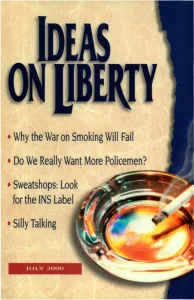
The Freeman: July 2000 Volume 50, 2000

This issue contrasts myth and reality in debates over health care, environmental policy, and consumer protection, arguing that political solutions often worsen the very problems they claim to address. Contributors defend markets in medicine, challenge environmental alarmism, and explore the economics of risk and choice. Additional articles examine trade, entrepreneurship, and the cultural foundations of liberty.
20121111 coveraug00small - Home

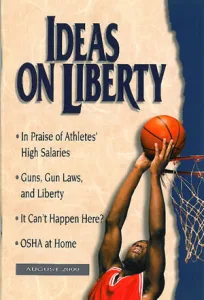
The Freeman: August 2000 Volume 50, 2000

This issue examines globalization, technological change, and immigration, emphasizing how openness and mobility enhance prosperity. Writers critique protectionism, central banking, and economic myths that justify state expansion. Additional essays analyze education, environmental policy, and the moral importance of individual autonomy.

20121111 coversep00small - Home

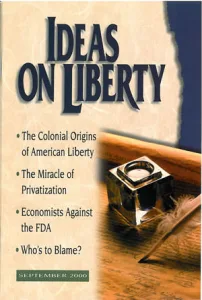
The Freeman: September 2000 Volume 50, 2000

This issue explores the growth of government power, the erosion of constitutional limits, and the dangers of political paternalism. Contributors critique campaign-finance reform, eminent domain abuse, environmental regulation, and the logic of coercive “public service.” Additional articles highlight market learning, entrepreneurship, and the benefits of competition.

20121111 coveroct00small - Home

The Freeman: October 2000 Volume 50, 2000

This issue highlights the successes of free markets and the failures of intervention, with essays on transportation policy, trade, and the economics of innovation. Authors challenge central planning in energy and infrastructure, showing how political monopolies distort incentives and hinder progress. Additional pieces address intellectual property, environmental claims, and the ethics of voluntary exchange.

20121111 covernov00small - Home

The Freeman: November 2000 Volume 50, 2000

This issue critiques rising political control over everyday life, from transportation and gasoline policy to federal law enforcement and federalism itself. Contributors highlight how incentives, regulation, and central planning distort markets, restrict mobility, and erode personal responsibility. Additional essays explore comparative advantage, constitutional limits, and the moral importance of voluntary social cooperation over political coercion.

20121111 coverdec00small - Home

The Freeman: December 2000 Volume 50, 2000

This issue explores how misunderstandings about markets, risk, and individual responsibility lead to misguided public policy in health care, poverty, and social welfare. Writers challenge the WHO’s critique of the U.S. health system, defend the cultural and moral lessons of popular media, and expose persistent economic fallacies surrounding regulation and redistribution. Additional essays address taxation, constitutional constraints, personal safety, and the enduring value of classical liberal ideas.

20121111 coverjun01small - Home

The Freeman: June 2001 Volume 51, 2001

This Bastiat-themed issue highlights Frédéric Bastiat’s life, his “seen and unseen” analysis, and his defense of property, harmony, and limited government as foundations of a free society. Authors revisit his influence on modern libertarian thought, debate moral vs. consequentialist justifications for liberty, and apply his insights to disability law, deregulation, foreign policy, racial profiling, and pollution. Additional pieces explore wonders of the market, energy policy, Keynesianism vs. laissez-faire, service-sector prosperity, and books on law, globalization, and the abuse of government power.

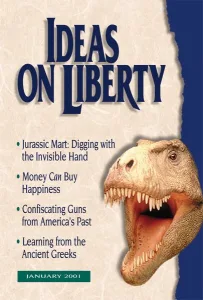
20121111 jan2001cvr1 - Home

The Freeman: January 2001 Volume 51, 2001

This issue explores how economic freedom raises living standards, increases happiness, and improves social cooperation, contrasting decentralized choice with the failures of political control. Contributors examine topics such as fossil ownership, gun confiscation in early America, egalitarian excess, mislabeling in politics, and the enduring lessons of the ancient Greeks. Additional essays critique antitrust, public-school drug policies, China–Taiwan diplomacy, and the ethics of government power.

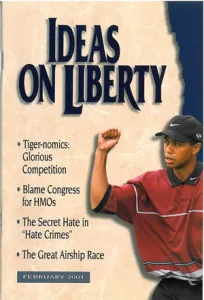
20121111 coverfeb01small - Home

The Freeman: February 2001 Volume 51, 2001

This issue critiques the political origins of HMOs, highlighting how congressional incentives distorted medical markets, undermined patient choice, and encouraged rationing disguised as “managed care.” Writers examine hate-crime legislation, property rights, urban development, European human-rights law, and the moral foundations of competition — even drawing lessons from Tiger Woods and the free-enterprise system. Additional pieces defend classical liberalism, expose bureaucratic overreach, and argue for patient-directed health decisions over government-designed systems.

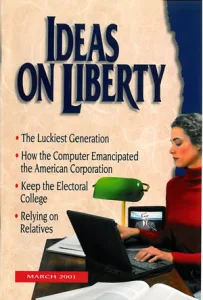
20121111 covermar01small - Home

The Freeman: March 2001 Volume 51, 2001

This issue celebrates the “luckiest generation,” showing how rising wealth, technological progress, and expanding choice have dramatically improved the prospects of young Americans. Contributors examine how computers have reshaped corporations, defend the Electoral College, and criticize drug policy, welfare reforms, and egalitarian schemes that erode responsibility and liberty. Additional essays explore creativity and resources, gun rights, education and school choice, pollution and efficiency, and the persistence of anti-capitalist sentiment in a world made rich by markets.

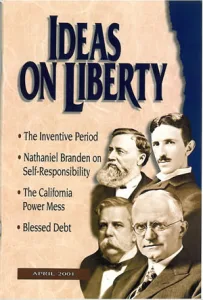
20121111 coverapr01small - Home

The Freeman: April 2001 Volume 51, 2001

This issue explores the nature of morality, choice, and economic understanding, showing how misconceptions about profit, value, and human behavior distort public policy. Contributors highlight the importance of voluntary exchange, responsibility, and the limits of government planning in education, markets, and personal decision-making. Additional essays examine political speech, classical liberal traditions, and the unintended consequences of well-meaning interventions.

20121111 covermay01small - Home

The Freeman: May 2001 Volume 51, 2001

This issue critiques modern environmentalism, arguing that many ecological claims ignore human welfare, economic reasoning, and historical context. Authors challenge myths about global warming, property rights, pollution, and the origins of ecological thinking, while highlighting how voluntary markets and scientific literacy provide better outcomes than coercive “ecologism.” Additional articles defend educational freedom, constitutional limits, economic liberty, and the enduring insights of Adam Smith.