The Freeman magazine was the flagship publication of the Foundation for Economic Education and one of the oldest, most respected journals of liberty in America. It was founded in 1950 through the efforts of John Chamberlain, Henry Hazlitt, Isaac Don Levine, and Suzanne La Follette. FEE acquired it in 1956, and within two years it had reached 42,000 subscribers.

Through its articles, commentaries, and book reviews, several generations of Americans have learned about the consequences and contradictions that flow from the illiberal policies of collectivism, interventionism, and the welfare state. For 66 years, The Freeman uncompromisingly defended the ideals of a free society.

FEE announced in September 2016 that the Fall 2016 issue would be the final edition of The Freeman magazine. Selected back issues are available at the FEE Store, and all issues are available here as downloads.

In June 2025, The Freeman was relaunched, but this time for the modern era on Substack. Subscribe for articles on markets, liberty, and culture from the perspective of anti-anti-anti-Communists.

Copyright Notice

Unless otherwise noted, and with the exception of John Stossel’s “Give Me a Break!” columns, all works published on FEE.org and FEE.org/freeman are published under a Creative Commons Attribution International License 4.0.

Feel free to share and copy as long as you credit FEE as the source.

Print Issues Archive

Filter by Year

20121111 coverjul02small - Home

The Freeman: July 2002 Volume 52, 2002

This issue examines how wealth is created, why economic freedom matters, and how political control over markets inevitably harms the least advantaged. Contributors address income inequality myths, the economics of immigration, the role of entrepreneurship, and common misunderstandings about labor markets. Additional pieces explore monetary policy, regulation, scientific innovation, and the cultural foundations of liberty.
20121111 coveraug02small - Home

The Freeman: August 2002 Volume 52, 2002

This issue explores medical freedom, bureaucratic overreach, and the contradictions of anti-market ideology, emphasizing how political control of healthcare and population policy produces harmful unintended consequences. Writers critique film-industry misconceptions, examine China’s institutional failures, and analyze judicial-commons tragedies driven by perverse incentives. Additional essays discuss monopoly myths, market medicine, communism’s legacy, and the roots of human happiness.

20121111 coversep02small - Home

The Freeman: September 2002 Volume 52, 2002

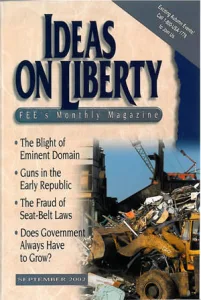
This issue exposes abuses of eminent domain, analyzes gun-history distortions, and critiques regulatory expansion that undermines personal and economic freedom. Contributors examine mass-transit misconceptions, Argentine plunder, Nozick’s defense of liberty, and the fallacies behind mandatory seat-belt laws. Additional essays explore equality, ecology, suicide policy, federal-prison industries, and the persistent growth of government.

20121111 coveroct02small - Home

The Freeman: October 2002 Volume 52, 2002

This issue investigates threats to privacy, the rise of national ID systems, and the political incentives behind corporate-blame shifting and economic regulation. Articles analyze global hunger, airline protectionism, racial inequality myths, New Urbanism, property rights for the poor, medical-innovation misperceptions, and the constitutional limits on war powers. Additional essays critique antitrust, drug policy, welfare for farmers, socialism’s failures, statistical abuse, and America’s drift toward centralized power.

20121111 covernov02small - Home

The Freeman: November 2002 Volume 52, 2002

This issue critiques government expansion, protectionism, and economic fallacies. It discusses how public policy often creates unintended consequences, especially in areas like trade, environmental regulation, and law enforcement. Several writers analyze persistent misunderstandings about capitalism, noting how interventionist policies harm the poor, distort markets, and reduce liberty. Historical essays revisit past policy failures, while book reviews emphasize classical liberal themes and defenses of voluntary cooperation.

20121111 coverdec02small - Home

The Freeman: December 2002 Volume 52, 2002

This issue explores widespread misunderstandings about markets, environmental policy, and the moral meaning of capitalism, showing how political intervention often harms the very people it claims to protect. Contributors challenge myths about resource depletion, technology, and corporate behavior while highlighting the historical and economic superiority of voluntary exchange. Additional essays examine taxation, constitutional limits, global development, and the persistence of collectivist thinking in modern policy debates.

20121111 coverjan03small - Home

The Freeman: January 2003 Volume 53, 2003

This issue explores how personal responsibility, voluntary action, and market incentives shape outcomes more effectively than political mandates. Contributors examine the misuse of antitrust law, myths about regulation, the incentives that drive real charitable behavior, and the long-term dangers of centralized state power. Additional essays highlight educational reform, constitutional limits, economic misunderstandings, and the moral foundations necessary for a free society.

20121111 coverfeb03small - Home

The Freeman: February 2003 Volume 53, 2003

This issue investigates how political incentives distort scientific research, public policy, and the pursuit of truth, contrasting state-sponsored orthodoxy with the competitive discipline of open inquiry. Authors examine environmental debates, welfare-state failures, market myths, and the unintended consequences of well-meaning regulation. Additional essays explore entrepreneurship, civil liberties, public-choice insights, and the cultural conditions that sustain a free society.

20121111 covermar03small - Home

The Freeman: March 2003 Volume 53, 2003

This issue highlights how regulatory power—especially within federal agencies—creates destructive incentives, from the Army Corps of Engineers’ arbitrary enforcement to FDA policies that threaten vaccine supplies. Contributors examine the economics of agriculture, Social Security’s compulsory and unsound structure, water-rights reform, the nature and morality of the corporation, the pitfalls of Keynesian policy, environmental mismanagement, and the unintended consequences of political decision-making. Additional essays explore energy economics, mental-health policy, deflation history, self-interest in markets, NCAA rule-evasion, states’ rights, diminishing civil liberties, and reviews on constitutional law, foreign aid, and Japan’s economic malaise.

20121111 coverapr03small - Home

The Freeman: April 2003 Volume 53, 2003

This issue critiques the growing fusion of surveillance and state power, showing how government efforts to collect information undermine privacy, civil society, and market dynamism. Contributors examine environmental misconceptions, European bureaucracy, California regulatory abuses, and the illusions behind “smart growth.” Additional articles address altruism, tax withholding, union power, and the lessons of past policy failures for preserving liberty.

20121111 covermay03small - Home

The Freeman: May 2003 Volume 53, 2003

This issue analyzes how political incentives shape philanthropy, consumer law, health-care policy, and education, emphasizing that coercion often harms the very people it claims to help. Essays explore the dangers of total information surveillance, the economic impact of Victorian environmental entrepreneurship, the meaning of democracy, and the roots of the progressive income tax. Additional pieces consider economic reasoning, union scandals, moral agency, and the cultural assumptions behind public policy.

20121111 coverjun03small - Home

The Freeman: June 2003 Volume 53, 2003

This issue explores the open-ended nature of knowledge and the dangers of using political power to impose technological, economic, or moral uniformity. Writers examine nonprofit myths, union-driven cost inflation, environmental misunderstandings, natural-rights debates, and the incentives behind U.S. policy toward Cuba. Additional articles address patriotism, regulation, competition, early industrial history, and the moral contradictions people accept when judging markets.