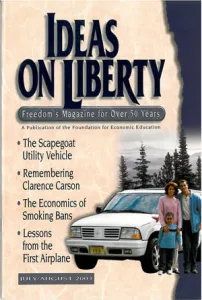
The Freeman: July/August 2003 Volume 53, 2003
Covers chemical hysteria, the debate around the new euro currency, and the Clinton administration’s environmental regulations.

Covers chemical hysteria, the debate around the new euro currency, and the Clinton administration’s environmental regulations.
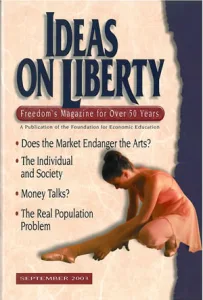
Discusses the illogic of conscription, the relationship between the market and the arts, and the enduring importance of FEE.
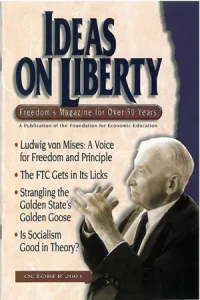
Explores the great life of Joseph P. Overton, the misleading nature of a study by the American Lung Association, and the key problems with Federal Trade Commission.
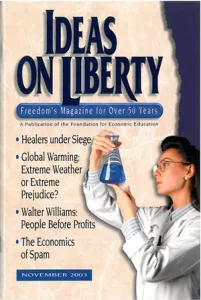
Reflects on foreign aid in Africa, the Supreme Court’s decision in Grutter v. Bollinger, and the economics behind spam emails.
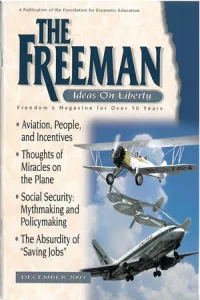
Comments on state-controlled educational bureaucracy, the role of incentives in aviation development, and the history of monetary central planning in the U.S.
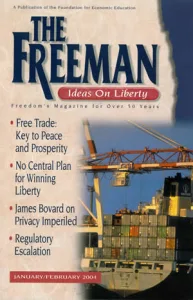
Criticizes federal surveillance and the nationalization of health care, in addition to reflecting on the story of V. K. Tolstoy.
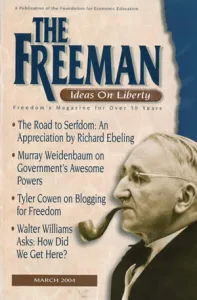
Highlights the federal trade deficit, misconceptions about minimum-wage law, and the genius of Hayek’s A Road to Serfdom.
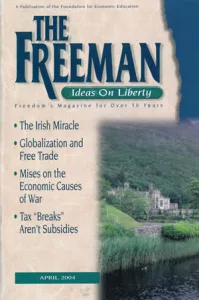
Discusses farm subsidies for developing countries, the economic causes of war, and the U.S. Census Bureau’s poverty numbers.
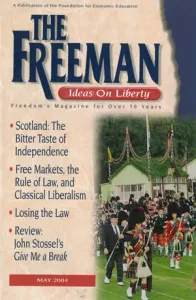
Examines the effects of telecom regulations, the relationship between free markets and the rule of law, and the lessons learned from a popular fairy tale.
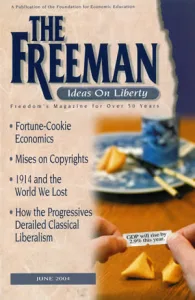
Covers the contributions of the Austrian school of economics, economic freedom in Bermuda, and the importance of choice.
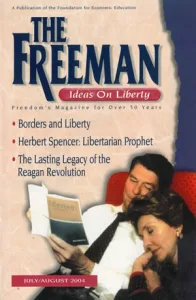
Highlights the WHO’s tobacco control treaty, the legacy of Reagan’s ideas, and the development of free-market ideas in Vietnam.
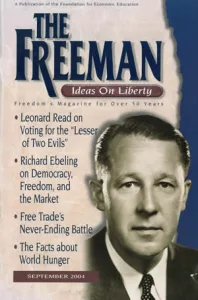
Reflects on democracy in Latin America, global energy supply, and responsible citizenship in a two-party system.