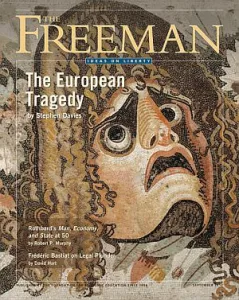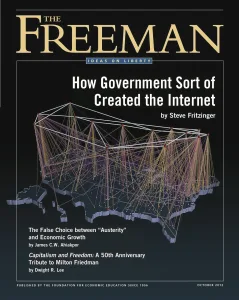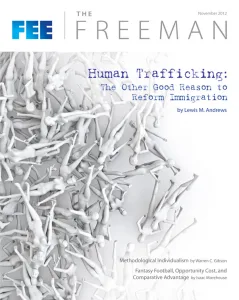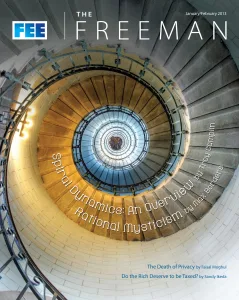
The Freeman magazine was the flagship publication of the Foundation for Economic Education and one of the oldest, most respected journals of liberty in America. It was founded in 1950 through the efforts of John Chamberlain, Henry Hazlitt, Isaac Don Levine, and Suzanne La Follette. FEE acquired it in 1956, and within two years it had reached 42,000 subscribers.

Through its articles, commentaries, and book reviews, several generations of Americans have learned about the consequences and contradictions that flow from the illiberal policies of collectivism, interventionism, and the welfare state. For 66 years, The Freeman uncompromisingly defended the ideals of a free society.

FEE announced in September 2016 that the Fall 2016 issue would be the final edition of The Freeman magazine. Selected back issues are available at the FEE Store, and all issues are available here as downloads.

In June 2025, The Freeman was relaunched, but this time for the modern era on Substack. Subscribe for articles on markets, liberty, and culture from the perspective of anti-anti-anti-Communists.

Copyright Notice

Unless otherwise noted, and with the exception of John Stossel’s “Give Me a Break!” columns, all works published on FEE.org and FEE.org/freeman are published under a Creative Commons Attribution International License 4.0.

Feel free to share and copy as long as you credit FEE as the source.

Print Issues Archive

Filter by Year

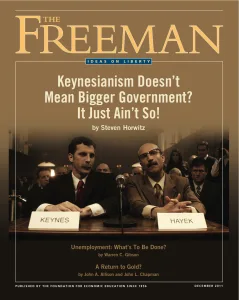
20121111 freemandec11coverfinal1 - Home

The Freeman: December 2011 Volume 61, 2011

This issue examines central planning and its long-term consequences, the role of economic literacy in shaping policy, and how decentralized knowledge leads to better decision-making. Classic economic principles are revisited to illustrate why free markets outperform state-controlled economies.
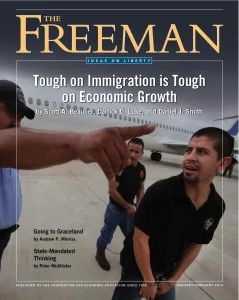
20121111 freemanjanfeb12coverfrontonly3 - Home

The Freeman: January/February 2012 Volume 62, 2012

The economic consequences of immigration policies are examined in this issue, with a focus on how restrictions affect labor markets and innovation. Additionally, it critiques various forms of government intervention that reduce economic efficiency and limit individual freedom.

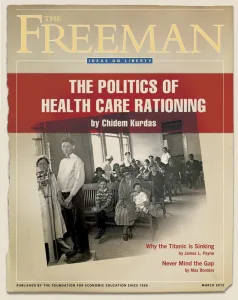
20121111 freemanmarchcoverlowres4 - Home

The Freeman: March 2012 Volume 62, 2012

This issue addresses the debate over government-created jobs and the economic realities of public-sector employment. It also critiques tax policies that claim to promote economic growth but often lead to unintended consequences, along with discussions on the political implications of healthcare rationing.

201211111 freemanaprilfinalcoverlowres - Home

The Freeman: April 2012 Volume 62, 2012

The complexities of tax policy and the myths surrounding fairness in taxation are key themes in this issue. It also looks at broader economic policies, questioning the effectiveness of government-driven economic planning versus the dynamism of free markets.

20121110 freemanmaycoverfinalfront1 - Home

The Freeman: May 2012 Volume 62, 2012

This issue explores ethical dilemmas in economic policymaking, including whether government ends justify questionable means. It also critiques federal training programs, highlighting inefficiencies and unintended consequences of state-led workforce development initiatives.

20121111 freemanjune12coverlr2 - Home

The Freeman: June 2012 Volume 62, 2012

Economic speculation, its role in price setting, and misconceptions about its impact on markets are explored in this issue. Other topics include a discussion on free-market economic principles and a historical analysis of regulatory overreach affecting small businesses.

20121111 freemanjulyaugcoverfront3 - Home

The Freeman: July/August 2012 Volume 62, 2012

The ethics of voluntary transactions and whether mutually beneficial exchanges can be exploitative are key themes in this issue. Leadership and statesmanship are also discussed, focusing on historical figures and their approaches to governance and economic policy.

20121001 issuecover - Home

The Freeman: September 2012 Volume 62, 2012

This issue commemorates the legacy of key economic thinkers and their contributions to free-market theory. It also critiques common misrepresentations of free-market economics in contemporary political discourse and challenges progressive narratives on regulation and intervention.

20121111 freemanoctcoverfrontonly1 - Home

The Freeman: October 2012 Volume 62, 2012

Corporate-government relationships and the often-overlooked critiques of corporatism are analyzed in this issue. Additional discussions focus on incentive structures in economic policy and the conflict between free speech and occupational licensing laws.

20121114 november2012freeman - Home

The Freeman: November 2012 Volume 62, 2012

This issue explores the historical narrative of the so-called robber barons, the ethical foundations of capitalism, and the case for gold-backed monetary systems. Discussions also focus on market-driven prosperity and the dangers of excessive government intervention.

20121206 freemandec12coverweb - Home

The Freeman: December 2012 Volume 62, 2012

The economic and political consequences of the European monetary system take center stage in this issue. Other topics include the unintended consequences of interventionist policies and an exploration of the fundamental principles of economic freedom.